
In Switzerland, at the start of last year 2024, the vote of the Grisons municipality of Surses caused a great stir. Just over two (car) hours from Zurich, the municipal assembly rejected the city of Zurich’s solar project from EWZ. And that in two votes with a resounding no each time.
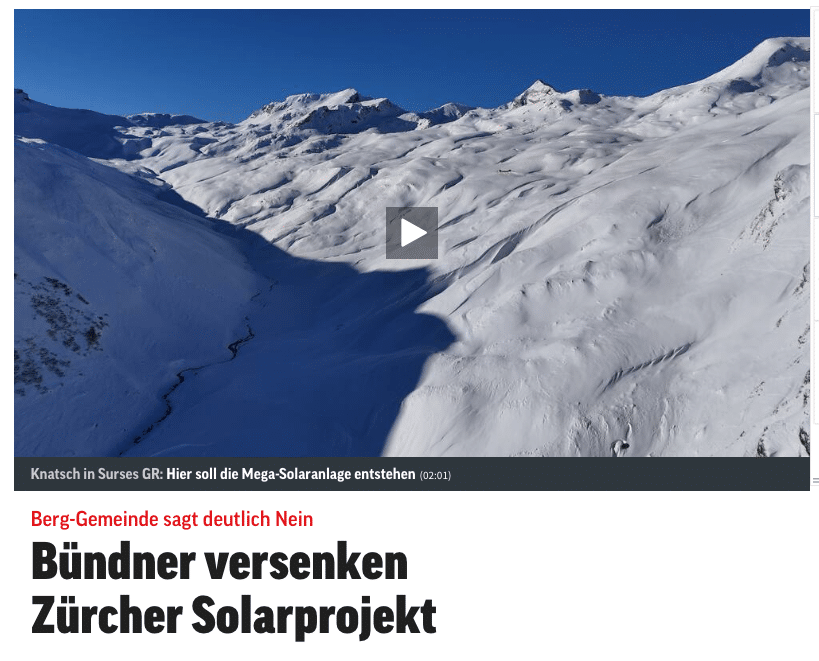
Headline from January 29, 2024, on 20-Minuten: Grisons sink Zurich solar project.
Here is a small media review from the perspective of participation. Various studies show that participation is absolutely necessary, especially for large projects these days. For energy projects, for example, the WSL Research Institute carried this out in more detail in 2022.
National litmus test or local circumstances?
No project manager likes working for the wastepaper basket. So how could it have come to the point where the result was so clear? In the run-up to the vote, individual media even interpreted it as a litmus test for the (Alpine) Solar Express. For example, Blick even initiated a live ticker for the vote in the run-up. However, we at enovation do not agree with the often fundamentally negative assessment of recent days. Because on the same day it could be read how the accelerated procedure in 2023 led to almost 10,000 approved systems in the canton of Zurich alone.
Four points that stand out from the perspective of participation
If the reporting is taken as a basis, a few critical points emerge from the perspective of participation and involvement. They have great potential, especially in such large projects. This applies both positively (they are taken into account) and negatively (they were not or were given too little attention). When reading the various reports, interviews and comments, four points in particular stand out.
Point 1: lack of transparency
The large (Alpine) solar projects are all under the greatest time pressure. Because companies that want to benefit from the Federal Council’s initiative must be connected to the grid by the end of 2025. But anyone who is under time pressure likes to forget the necessary transparency. What most people certainly know from their private lives (“just do it now”) often leads to objections in large projects, which can then only be expressed at the ballot box. Transparency is therefore essential from the start and throughout the entire (planning) process. One-off actions (such as with just one information event, if the municipality’s website is correct) can hardly/cannot do this.
Point 2: Stakeholder communication
It has been proven to be a key factor in large projects. However, dialogue is only participatory if it also leaves those involved with a certain amount of leeway. Here, the EWZ seems to have been active with certain stakeholders, as has been emphasized in various interviews (a list can be found in the media presentation). It seems that the environmental and nature associations were able to be convinced. However, it is obvious that the farmers and tourism managers, two central target groups (personally affected), could not be reached. And that, even though tourism could have benefited from a lot of money. Well, if you now look at the communication about the project on the company website, you read about a “national flagship project” (which is also at the top of the media presentation again). This may certainly be true for the municipal utility itself, but it does not count for those affected locally. They assess the direct influence on their living, working and living space. Which brings us to the next point.
Point 3: Factor of concern
In a witty press comment, it was said that the Swiss population probably supports the general goals of the energy transition, but puts up too much resistance to concrete projects. Well, from a participatory point of view, this behavior is not surprising: as a method, participation aims precisely to pick up on different needs – yes, one can say that participation exists precisely because of this behavior. And as the study mentioned at the beginning shows, 70 percent of those affected by large projects want participatory involvement.
Point 4: Use resources wisely
If the residents of affected and surrounding communities are involved in a contributing and early manner, this demonstrably increases the acceptance of a project. This naturally also requires financial and personnel resources – but less in glossy brochures, but more in participatory workshops, local inspections or many other possible formats. As can be read on the EWZ website, there were information events in three municipalities. However, from the perspective of participation, information is only the basis and does not represent a form of participation.
Conclusion: Learn lessons, develop projects further
Of course, there would be other points that could be mentioned in this review. This applies to participation itself, but also to political or social developments. Nevertheless, it seems advisable to adapt the future approach to the projects. It makes sense to provide the project managers with the necessary (external) support. Because even if the 200 solar projects of the solar initiative can hardly be realized within the desired timeframe, the strategic goals (less dependence on foreign countries, more winter electricity, which the EWZ also emphasizes) require that we all pull together – we need a togetherness.
Photo by Tanathip Rattanatum on pexels.